
By TAD Editorial Team
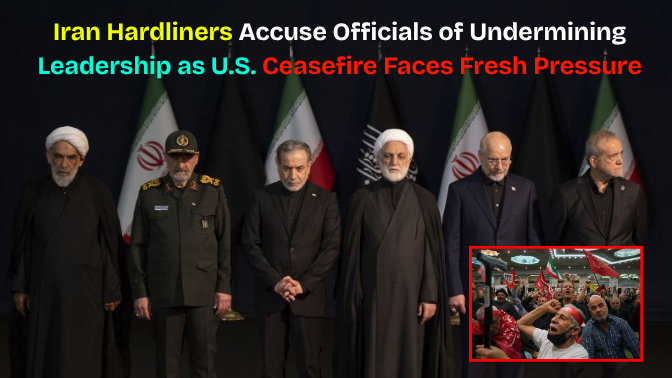
TEHRAN, July 19 (TAD) — Political divisions within Iran appear to be deepening as hardline factions intensify criticism of senior government officials, accusing them of weakening the country’s revolutionary leadership following a ceasefire agreement with the United States.
The accusations surfaced during funeral events held for Iran’s former Supreme Leader, Ali Khamenei, where some mourners directed hostile slogans at President Masoud Pezeshkian and senior officials involved in negotiations with Washington instead of focusing solely on memorial tributes.
Iranian Foreign Minister Abbas Araghchi, who helped negotiate the ceasefire and limited sanctions relief, reportedly left one funeral gathering after protesters confronted him with chants labeling him a “traitor.” Local reports also described objects being thrown toward officials during the event.
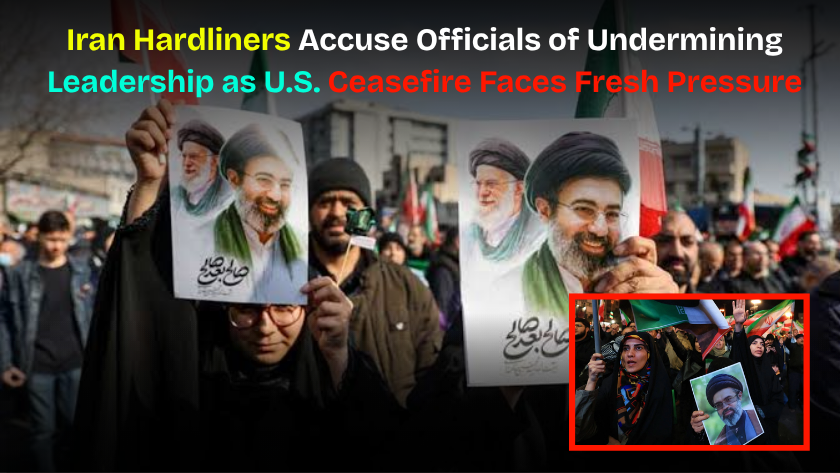
Hardline politicians and conservative groups have claimed that government leaders are making political decisions without fully reflecting the guidance of the country’s new Supreme Leader, Mojtaba Khamenei, who has remained largely absent from public appearances since assuming leadership. Some conservative lawmakers have publicly alleged that senior officials are attempting to consolidate power while the new leader remains out of public view. No evidence has been publicly presented to substantiate claims of a coordinated “coup.”
Among those facing criticism are President Pezeshkian, Parliament Speaker Mohammad Bagher Ghalibaf, and Foreign Minister Araghchi, all of whom have played prominent roles in managing Iran’s post-war diplomacy and domestic affairs.
The political tensions have grown as Iran’s fragile ceasefire with the United States comes under renewed strain. Recent attacks on commercial shipping in the Strait of Hormuz, attributed by U.S. officials to Iran’s Revolutionary Guards, prompted retaliatory military action by Washington and renewed calls from Iranian hardliners to abandon the ceasefire agreement.
Several conservative figures have also issued strong warnings against continued diplomatic engagement with the United States. Some lawmakers have accused negotiators of crossing political “red lines,” while others have argued that Iran should adopt a more confrontational approach toward Washington.
Observers say the disagreements reflect competing visions within Iran’s political establishment rather than a complete breakdown of government authority. While conservative factions continue pressing for a tougher stance, many officials appear focused on preserving stability, easing international pressure, and maintaining sanctions relief achieved through recent negotiations.
Political analysts note that although public disagreements have become more visible, Iran’s leadership broadly shares strategic interests in protecting national security and maintaining influence over key regional waterways, including the Strait of Hormuz.
The developments highlight the growing challenge facing Iran’s leadership as it seeks to balance internal political rivalries with increasing regional tensions and diplomatic pressure.
TAD Editorial Team
This report was independently prepared by the TAD Editorial Team using publicly available information from multiple international news organizations. The article has been rewritten in TAD’s editorial style to provide readers with a balanced, fact-based, and independently written account of the latest developments.
TAD Analysis
The current political dispute in Iran appears to reflect a broader struggle over how the country should respond after months of conflict and international pressure. While hardline factions favor a more confrontational approach, other senior officials appear to view diplomacy and limited engagement as a way to reduce economic pressure and preserve national stability.
The public absence of Supreme Leader Mojtaba Khamenei has added uncertainty to Iran’s political landscape, creating space for speculation and competing narratives among different political factions. However, many of the allegations currently circulating—such as claims of an internal “coup”—remain political accusations rather than independently verified facts.
The future of the U.S.–Iran ceasefire is likely to depend not only on developments between the two countries but also on how Iran manages its internal political divisions. Continued instability inside the country’s leadership could complicate future negotiations and increase uncertainty across the wider Middle East.
Sources: CNN, Iran International, The Times of India.

