

By TAD Editorial Team
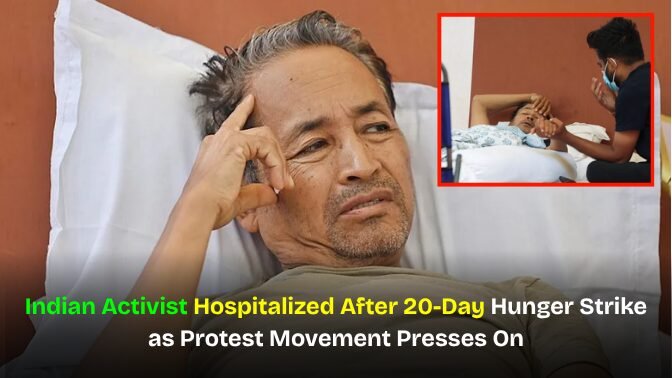
NEW DELHI, July 19 (TAD) — Indian activist and educationist Sonam Wangchuk has been admitted to a government hospital after completing a 20-day hunger strike in New Delhi, where he had been protesting in support of a student-led campaign demanding reforms to India’s examination system.
Police and paramilitary personnel moved Wangchuk from the protest site at Jantar Mantar early Saturday morning after authorities determined that his health required immediate medical attention. Videos shared online showed security forces clearing the area before transporting him by ambulance.
His wife, Gitanjali Angmo, later confirmed that Wangchuk had been admitted to Safdarjung Hospital.
Delhi Police said the action followed a Delhi High Court order directing authorities to monitor the activist’s condition and provide medical treatment if necessary. Officials stated that the decision was based on medical advice after Wangchuk’s health deteriorated during the prolonged fast.
The 59-year-old activist had reportedly survived for nearly three weeks by consuming only water and salt, losing more than nine kilograms during the protest. Despite his declining physical condition, Wangchuk had repeatedly insisted that he intended to join a planned march to India’s Parliament on Monday.
Following his hospitalization, Cockroach Janta Party (CJP) founder Abhijeet Dipke announced that he had begun an indefinite hunger strike in Wangchuk’s place. Protest organizers said the parliamentary march would proceed as scheduled, arguing that the movement would continue despite Wangchuk’s removal.
The Cockroach Janta Party began earlier this year as an online satirical campaign highlighting repeated examination paper leaks and alleged irregularities affecting India’s national entrance examinations. The movement has since expanded into nationwide protests supported by students, activists, and civil society groups calling for greater transparency and accountability in the country’s education system.
Protesters continue to demand the resignation of Education Minister Dharmendra Pradhan, arguing that he should accept responsibility for the examination controversies. Following Saturday’s police action, organizers also broadened their demands by calling for Prime Minister Narendra Modi to step down, accusing the government of failing to address public concerns over education reforms.
Several opposition leaders criticized the removal of Wangchuk from the protest site, describing the police operation as an excessive response against a peaceful demonstration. They urged the government to engage in dialogue with protesters rather than relying solely on law enforcement measures.
Government officials have maintained that Wangchuk’s hospitalization was carried out strictly on medical grounds and in accordance with the court’s instructions to protect his health.
TAD Editorial Team
This article was prepared by the TAD Editorial Team using publicly available information from multiple international news organizations. The report has been independently written to provide readers with a clear, balanced, and factual account of the developments.
TAD Analysis
The hospitalization of Sonam Wangchuk marks another significant moment in India’s ongoing debate over education reforms and public accountability. While authorities have argued that medical intervention was necessary to protect the activist’s health, the manner in which the operation was carried out is likely to remain a subject of public and political discussion.
The continued determination of protest organizers suggests that the movement has evolved beyond the case of a single activist. Instead, it reflects broader concerns among students and civil society regarding examination integrity, institutional transparency, and public trust in the education system.
Moving forward, meaningful dialogue between the government and protest representatives could play an important role in reducing tensions. Whether policymakers choose negotiation, reform, or continued enforcement may significantly influence public confidence in India’s democratic institutions and education governance.
Sources: BBC News, ABC News, ABC Australia.

